Why Is Your Aircon Running but Not Cold?
Ever stood under your wall-mounted unit, felt the fan blowing, and wondered why the room still feels warm? It’s a frustrating one, but an aircon not cold repair almost always starts with a cause you can find.
The usual suspects are a dirty evaporator coil, low refrigerant pressure, an outdoor unit that has stopped working, or a failed electrical part. A 2026 troubleshooting guide from Afix points to the dirty coil as the most common cause in Singapore’s humidity. Each cause needs a different fix, and each has a different price.
That’s why we find the cause before we quote. You shouldn’t pay for a gas top-up when the coil is the problem, or for a chemical wash when a capacitor has failed. Repairs start from S$60, with a fixed quote before any work begins.
How Is the Cause Found?
Brian started Cool Earth Aircon in 2007 as a one-man workshop, and the order of checks we use hasn’t changed much since. We go from the simplest, cheapest cause to the most involved:
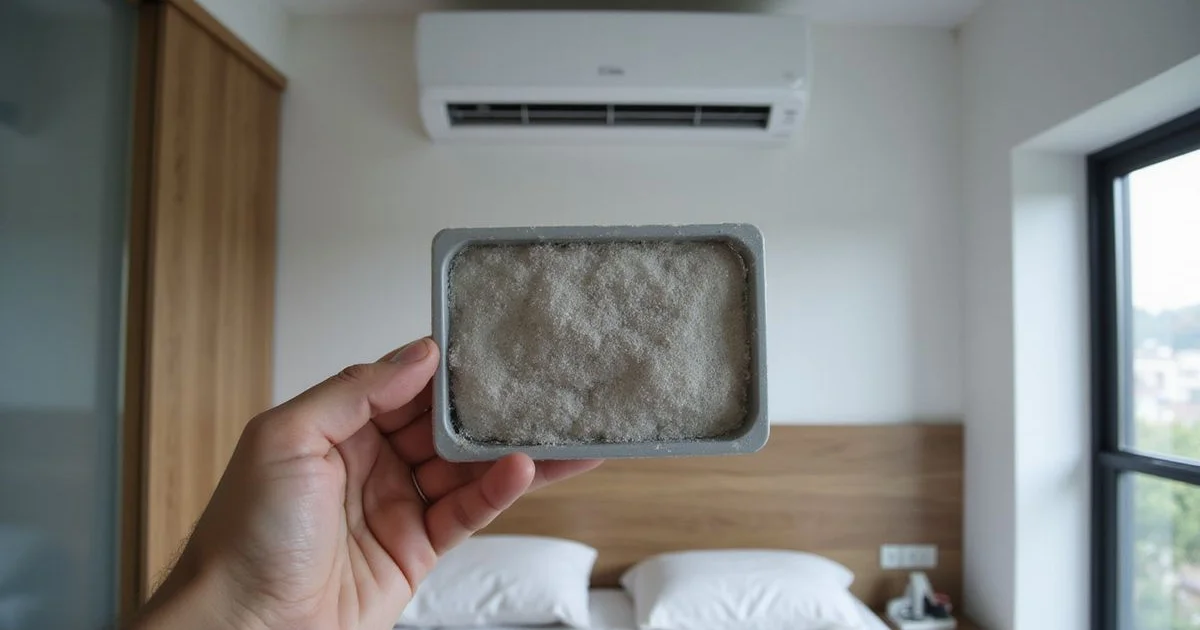
- Filters and coil. Dust on the filters and grime on the coil block airflow. Billy Aircon notes that fine dust builds up into an insulating layer on the coil over 6 to 12 months, even if you clean the filters. A quick look and an airflow reading show if dirt is the problem.
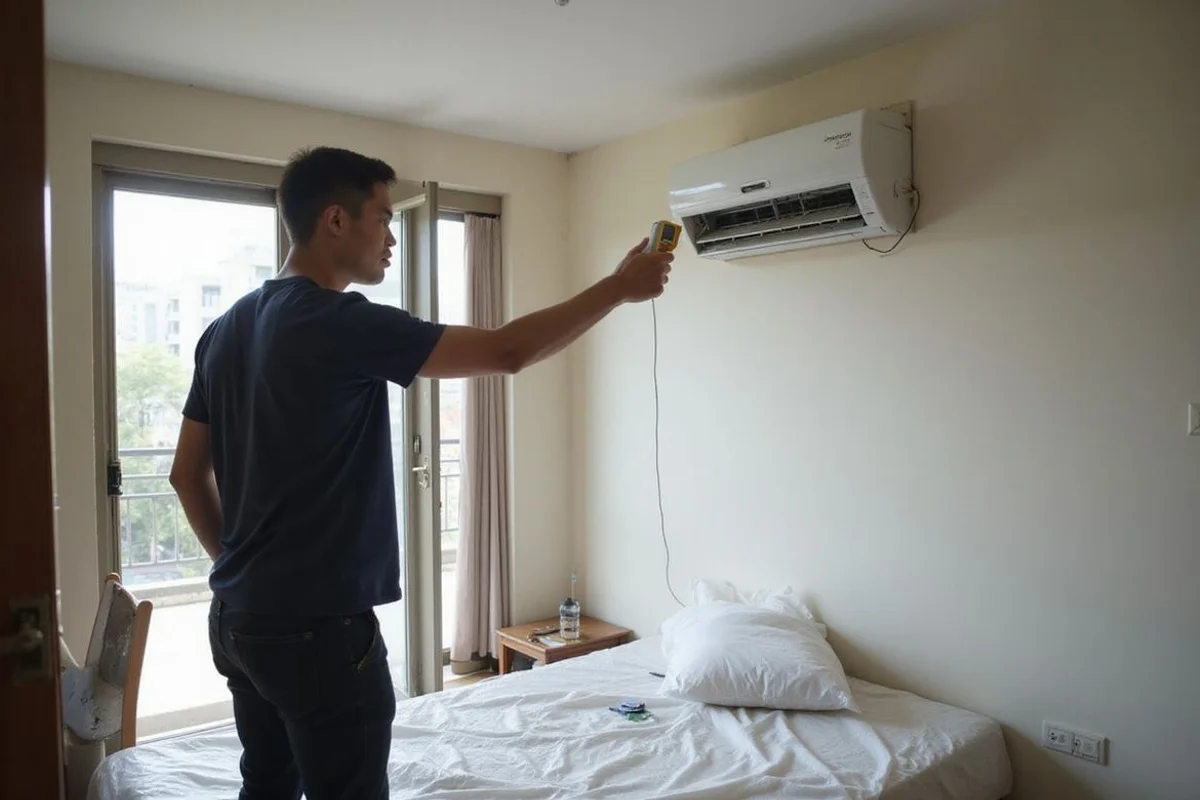
- Airflow and vent temperature. We measure the air coming out of the vent, so there’s a number to compare before and after.
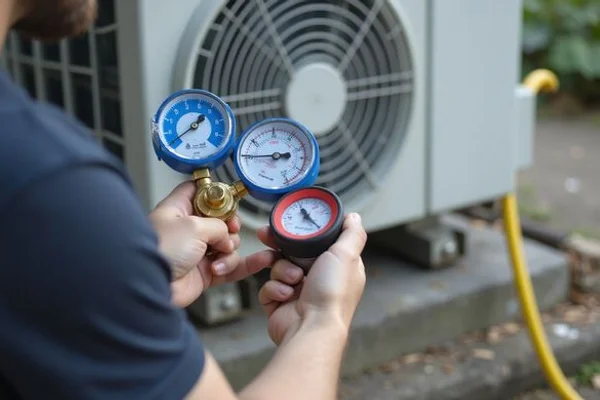
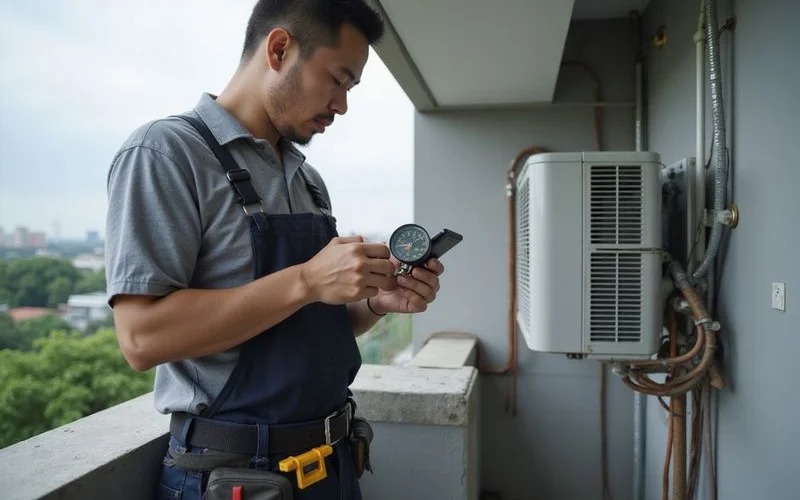
- Refrigerant pressure. A manifold gauge on the outdoor unit shows whether the system is low. R32 refrigerant and R410A refrigerant systems run at different pressures, and R32 runs at the higher one, so we check the reading against the right figure.
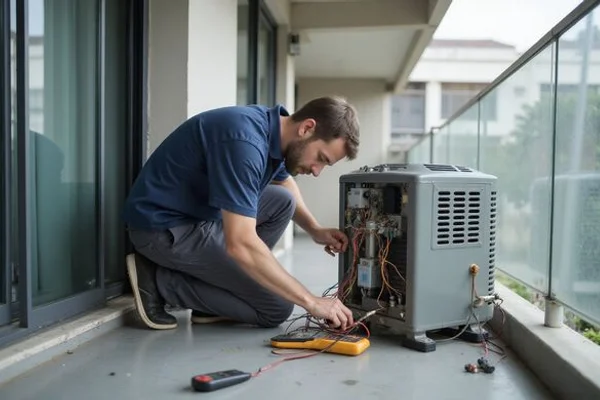
- Outdoor unit. If the condenser unit isn’t running, or the compressor won’t start, we test its capacitor, contactor and fan.
- Sensors. A faulty thermistor can tell the unit the room is already cold, so it stops cooling early.
At the end, you hear which one it is, in plain words, with the price.
What Fixes Are There?
The fix depends on what the checks find. Here’s how each cause maps to a service:
| What we find | The fix |
|---|---|
| Dirt on the coil | General servicing |
| Dirt deep in the blower wheel | Chemical wash |
| Low refrigerant | Gas top-up, with a leak check |
| A failed part | Repair, with the part quoted first |
Every gas top-up includes a leak check, because a sealed system only loses gas through a leak. Topping up without finding the leak just means you’ll be calling us again in a few weeks.
Price matters here too. According to a 2026 guide from aircons.sg, gas top-ups in Singapore run from about S$60 to S$180 per unit, depending on the refrigerant type. Most HDB units in Ang Mo Kio are newer R32 or R410A systems, so that quote should stay on the lower side.
Common Problems We Solve
Blowing warm air
When the indoor fan runs but the air is warm, the outdoor unit is often not doing its job. A failed capacitor or fan motor outside is a common cause, so we check it before assuming anything else.
Don’t leave this one for weeks. Aircon Connection warns that a capacitor fault left alone can burn out the compressor, which turns a small repair into a big one.
Cold for a while, then warm
A unit that starts cold and then warms up may have an outdoor unit that cuts out when it overheats, a weak capacitor, or low gas. Aircon Connection lists “cold at first, warm after about 30 minutes” as a sign of a frozen evaporator or low refrigerant.
We test during the warm phase, because that’s when the fault shows itself. If you can, leave the unit running and tell us roughly how long it takes to turn warm.
Ice on the copper pipe
Ice on the pipe or the coil usually means low refrigerant or very poor airflow. Switch the unit off to thaw while you wait, as running it iced up strains the compressor.
Be patient with the thaw. Carrier says light frost can melt in about 1 to 3 hours, while heavy ice can take 4 to 8 hours or longer. Running the fan only (no cooling) can speed things up a little.
One room cold, another not
On a multi-split System 3 or System 4 setup, one outdoor unit feeds several rooms. If only one room is warm, we check that room’s indoor unit or line first.
These systems are common in condos near Ang Mo Kio Town Centre. If you have two to four separate wall-mounted units in your flat, the same logic applies: the one that’s warm tells us where to look.
Can Weak Cooling Raise Your Bill?
Yes. When airflow is blocked or refrigerant is low, the compressor runs longer to reach the temperature you set, and some units never reach it at all. That extra running time shows up on the electricity bill before you notice the room is warmer.
It adds up fast. City Cooling Engineering estimates that aircon makes up 60 to 70% of a typical Singapore household’s electricity use, so a struggling unit is expensive to ignore. An older non-inverter unit that never seems to cut off is a common example.
Fixing the cause usually brings both the cooling and the running time back to normal. Regular servicing every 3 to 4 months keeps the coil and filters clear, which is the simplest way to stop weak cooling from creeping back. That sits close to the quarterly schedule widely cited for Singapore homes, which SACES says is also the NEA’s guidance for residential units.
Before You Book
Two quick checks are worth doing yourself:
- Make sure the remote is set to cool mode, not fan or dry.
- Look at the filters. If they’re grey with dust, a clean may bring back some cooling.
Our guide on cleaning filters yourself shows how to do it safely. If the room is still warm, WhatsApp us with what you see. Same-day slots are available subject to availability.